When you first start looking into classes of trademark, it can feel way more confusing than it should. You just want to protect your brand, but then suddenly you’re trying to figure out numbers, categories, goods, services, and whether you’re even choosing the right class.
This blog post will break down in a simple and easy way, so you can understand what they mean and how they work. You’ll learn how to choose the right class for your brand, avoid common mistakes, and feel more confident before filing.
Trademark Class
A class of trademark is the legal category that tells the USPTO what kind of goods or services your mark represents. In simple terms, it helps the United States Patent and Trademark Office sort applications, review registration details, charge the right fee, and search for registered or pending trademarks in its database.
In real filing work, I’ve seen people focus too much on the name and not enough on the classification. That is where many mishaps, delays, and even a formal refusal begin.
Goods and services come first
Every application starts with a basic question: are you offering Goods, Services, or both? Goods are products that customers purchase, such as bicycles, candles, shirts, t-shirts, tops, clothing, coffee, beer, bags, or jewelry. Services are activities performed for the benefit of someone else, such as bicycle repair, catering, retail, construction, education, entertainment, legal, or financial work.
This sounds easy, but it becomes tricky when a company, brand, or online store sells a product and also offers a service under the same mark. A shop can sell notebooks, pens, folders, and paper, while also running online retail store services.
A restaurant can serve meals and also sell branded coffee beans, maple syrup, sauces, syrups, candies, desserts, or drinks. That is why one brand often needs multiple classes for full protection.
Why identification matters so much
The next step is identification. Your identifications must be clear, concise, and easy for the general public to understand. They should accurately and completely describe the goods or services you actually sell. If your wording is too vague, too broad, or too miscellaneous, it can lead to a denial of a filing date, an initial refusal, or an office action issued by an assigned examining attorney.
For example, if your brand covers black, short-sleeved t-shirts, you should not give a lazy or overly general description. You need an accurate, acceptable description that fits the right class. That is why people use the ID Manual, look at pre-approved descriptions, and sometimes draft a new description for an additional fee.
If needed, you can suggest a new identification by following the instructions on the Suggestions page, where it may be reviewed by the Administrator under Policy and Practice rules before it is automatically entered. From experience, this is one of the biggest places where careful wording saves both time and money.
How trademark classes are organized
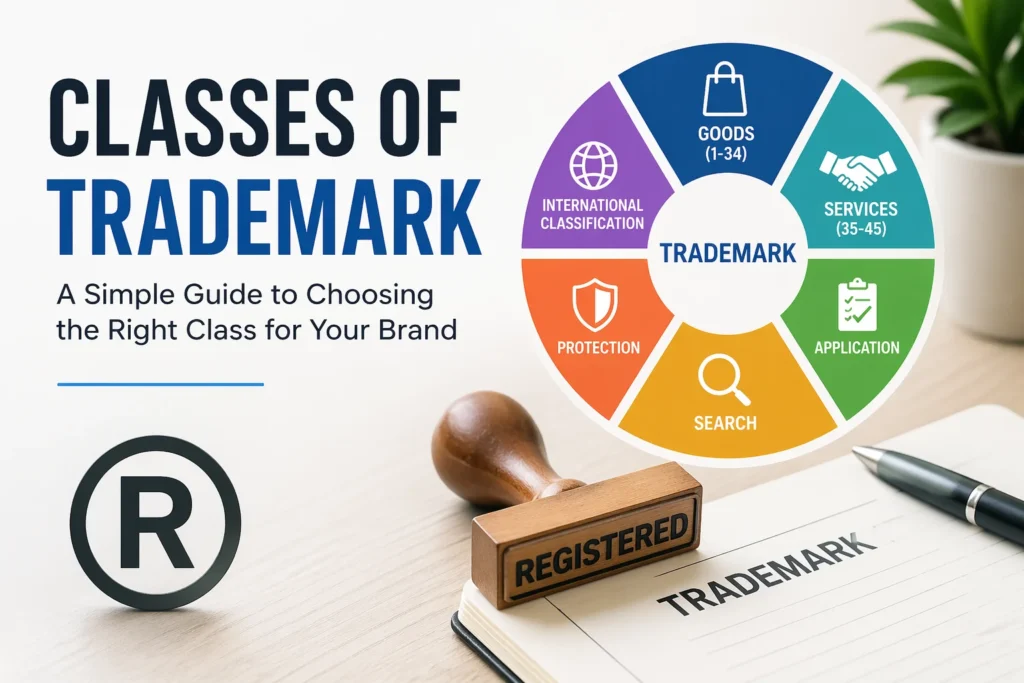
The classes exist to organize goods and services used in applications, assess fees, and aid in searching the database for trademarks. The system is organized into broad categories, and each category is given a number from 1 to 45. You may also see the same system shown as 001 to 045. These are known as international classes because they come from an international agreement.
There are 45 total classes. 34 cover goods, and 11 cover services. The USPTO sorts marks into these classes, recognizes the correct type, and often assigns the most suitable class based on the goods or services you specify. Still, it can be difficult to choose the best fit, especially with hybrid offers, merch, online businesses, and connected products and services.
Nice Classification and worldwide use
The Nice Classification system was created under the Nice Agreement. As of December 2025, 96 countries had adopted it, and around 150 trademark offices worldwide used it. That matters because a growing number of businesses want local protection first and then broader or even international protection later.
You may also see older references to obsolete USPTO US Trademark Classes. Before 1973, the United States had its own structure, including 52 Goods classes and eight Services categories, plus older references tied to Collective Membership and Certification marks. Once the United States entered the treaty in 1973, that older system was effectively nullified for current filing. Today, the Nice Trademark Classes are the standard categorizations used in U.S. practice.
Why classes affect cost
A class of trademark is not only about paperwork. It also affects costs. The modern base filing fee is often shown as 350 per class, so one class can mean $350, while two classes can make the case 700.
In older or alternative fee discussions, you may also see TEAS Plus at 250, TEAS Reduced Fee (RF) at 350, TEAS Regular at 400, and a higher amount like 275 mentioned when a special description must be created outside the standard ID Manual.
The practical point is simple. If you file under one class, you pay once. If your application covers different kinds of goods and services, you may pay more. That is why smart choosing always involves budget, marketing plans, and the real commercial value of the products or services you want to protect.
I always tell people to think beyond the first application and ask where the brand is going next. That mindset helps you proceed with fewer surprises.
How to choose the right class
A good way to start is to ask a few practical questions.
First, are you selling a product, a service, or both? Second, do you plan to sell something new later? Third, how will you describe your offer in a way that is specific, appropriate, and acceptable? These basic questions help you narrow your selection and determine the right class or multiple classes.
Suppose you sell hair dryers now and straighteners later. You might need one class for current use-in-commerce and another for intent-to-use. Suppose you sell golf shirts, dress shirts, or a custom t-shirt printing line.
Some items may fall into one class, while the printing or retail side may fit another. A lot of applicants do not expect that. They think a single description will cover everything, then find out the offer is stretched across more than one class.
Goods can move across more than one class
This is one of the most misunderstood parts of trademark work. A single kind of good can appear in multiple classes. The USPTO often divides goods by what they do, how they are used, or what they are made from.
Take blankets. It sounds like one simple product, but it can spread across several categories. Blanket throws, fleece, swaddle, picnic, bed, and pet blankets usually sit in 24.
Therapeutic or weighted blankets for medical purposes can fall in 10. Electric blankets are in 11. Horse or saddle blankets can sit in 18. Wearable blankets may fit 25. If you sell more than one type, you should know that upfront.
That same idea applies to merchandise, promotional goods, and self-branded items. A business can sell hats, mugs, beverage glassware, totes, bags, pins, or key chains. Those products do not all land in one place. The classes can spread depending on the item.
When one business needs more than one class
Many businesses qualify for at least two classes. One class may cover the products they sell, and another may cover the service they provide through the same channel.
An online or brick-and-mortar store that makes and sells its own goods is a classic example. Think of a shop selling stationery under the PURPLE CHEETAH brand. It might manufacture notebooks, pens, folders, and paper in Class 16, while also offering Class 35 retail services through a website, trade shows, and craft fairs.
Food brands do this too. A cafe, eatery, or brewpub can offer restaurant services under Class 43, while its own coffee beans, maple syrup, or beer may fit Class 30 or Class 32. The same logic applies to artists, stores, and tourist brands that sell merchandise alongside the main service.
Coordinated classes and conflict checking
A good search is not only about finding identical names. It is about spotting potentially conflicting marks. A conflicting mark is one that is similar in appearance, sound, or meaning, and is tied to goods or services that are related, competing, or sold to the same customer group.
That is why coordinated classes matter. Two classes are coordinated when the goods or services are closely connected. They may be identical, similar, complementary, or competitive. They may be used together, advertised together, or sold by the same manufacturer or dealer. A common example is Jewelry in 14 and clothing in 25.
In practice, when an examiner reviews your application, they look for conflicts in the USPTO database. If they see a strong likelihood of confusion, they can issue a refusal. That is why a basic search is helpful, and a broader search is often even better.
Same name, different class
The class system also explains why some famous names can coexist. Delta can be used for faucets and airlines. Pandora can cover jewelry and music streaming. Graco can apply to baby products and industrial products. The names are the exact same, but the pairs sit in different commercial spaces, so the chance of confusion may be lower.
The same idea appears with logos. Marmot and Motorola have been discussed because of their visually similar M logos. But even when marks look close, the final legal question is not only the image. It is also whether the goods, services, and commercial context create real conflict.
Design search codes for logo marks
For a word mark, people usually search text. For a logo, the USPTO uses Design Search Codes. These are six-digit numbers that help classify design elements.
If your logo includes a bird, for example, you may search codes like 15.01 for Eagles, 15.05 for Turkeys, 15.07 for Owls, and 15.10 for Doves. The first digits point to a broader category, such as 03 for animal design elements. Another number can identify the division, such as birds and bats, and the final identifier gets more specific.
This is useful because brands like Twitter, Nestle, NBC, Hollister, and Dove all rely on visual identity. Without search codes, you could end up browsing Countless logos in the wrong lane.
Goods classes 1 to 34
Classes 1 to 5
Class 1 covers Chemicals used in industry, science, photography, agriculture, horticulture, and forestry, including unprocessed artificial resins, plastics, manures, fire extinguishing compositions, tempering, soldering, chemical substances, preserving foodstuffs, tanning, and adhesives.
Class 2 covers Paints, varnishes, lacquers, preservatives against rust and deterioration of wood, colorants, mordants, raw natural resins, and metals in foil or powder form for painters, decorators, printers, and artists.
Class 3 includes Cosmetics, cleaning preparations, Bleaching products, laundry substances, polishing, scouring, abrasive preparations, soaps, perfumery, oils, hair products, lotions, and dentifrices.
Class 4 includes Lubricants, fuels, Industrial greases, dust absorbing, wetting, and binding compounds, motor spirit, illuminants, candles, and wicks.
Class 5 covers Pharmaceuticals, Pharmaceutical and veterinary products, sanitary preparations, dietetic goods, products for babies, plasters, dressings, dental materials, wax, disinfectants, products for destroying vermin, plus fungicides and herbicides.
Classes 6 to 10
Class 6 covers Metal goods such as alloys, building materials, transportable buildings, railway tracks, non-electric cables, wires, iron hardware, pipes, tubes, safes, and ores.
Class 7 covers Machinery, Machines, machine tools, motors, engines, coupling, transmission components, agricultural implements, and incubators for eggs.
Class 8 includes Hand tools, implements, cutlery, side arms, and razors.
Class 9 covers Electrical and scientific apparatus, nautical, surveying, photographic, cinematographic, optical, weighing, measuring, signaling, checking, lifesaving, teaching tools, plus recording, reproduction, images, magnetic data carriers, discs, automatic vending mechanisms, coin systems, cash registers, calculating devices, processing equipment, and computers.
Class 10 includes Medical, Surgical, dental, and veterinary apparatus, instruments, artificial limbs, artificial eyes, orthopedic items, and suture materials.
Classes 11 to 15
Class 11 covers Environmental control apparatus for lighting, heating, steam generating, cooking, refrigerating, drying, ventilating, water supply, and sanitary uses.
Class 12 covers Vehicles and locomotion by land, air, or water.
Class 13 includes Firearms, ammunition, projectiles, explosives, and fireworks.
Class 14 covers Jewelry, Precious metals, coated goods, stones, horological and chronometric instruments.
Class 15 covers Musical instruments.
Classes 16 to 20
Class 16 includes Paper, printed matter, cardboard, bookbinding, photographs, stationery, household adhesives, paint brushes, typewriters, office requisites, instructional material, plastic packaging, playing cards, printing blocks, and related matter.
Class 17 covers Rubber, gutta-percha, gum, asbestos, mica, extruded plastics, packing, insulating, and flexible materials.
Class 18 covers Leather, imitations of leather, skins, hides, trunks, traveling goods, umbrellas, parasols, walking sticks, whips, harness, and saddlery.
Class 19 covers Non-metallic or Nonmetallic building materials, rigid pipes, asphalt, pitch, bitumen, transportable structures, and monuments.
Class 20 includes Furniture, articles otherwise classified elsewhere, mirrors, picture frames, cork, reed, cane, wicker, horn, bone, ivory, whalebone, shell, amber, mother-of-pearl, meerschaum, and substitutes.
Classes 21 to 25
Class 21 includes Housewares, glass, kitchen utensils, containers, combs, sponges, brush-making materials, steel wool, un-worked and semi-worked glass, glassware, porcelain, and earthenware.
Class 22 covers Cordage, fibers, Ropes, string, nets, tents, awnings, tarpaulins, sails, sacks, padding, stuffing, and fibrous textile material.
Class 23 covers Yarns and threads.
Class 24 covers Fabrics, Textiles, textile goods, table covers, and bed-related fabric goods.
Class 25 covers clothing, footwear, and headgear.
Classes 26 to 30
Class 26 includes Fancy goods like Lace, embroidery, ribbons, braid, buttons, hooks, needles, and flowers.
Class 27 covers Floor coverings such as Carpets, rugs, mats, matting, linoleum, and materials for covering floors, plus wall hangings made from non-textile material.
Class 28 includes Toys, sporting goods, Games, playthings, gymnastic articles, and decorations for Christmas trees.
Class 29 covers Meats and processed foods, including Meat, fish, poultry, game, extracts, preserved, dried, and cooked fruits and vegetables, jellies, jams, fruit sauces, milk, and edible fats.
Class 30 covers Staple foods like cocoa, rice, tapioca, sago, flour, cereals, bread, pastry, confectionery, ices, honey, treacle, yeast, baking-powder, salt, mustard, vinegar, condiments, spices, and ice.
Classes 31 to 34
Class 31 includes Natural and agricultural products, horticultural goods, grains, animals, fresh produce, seeds, plants, and malt.
Class 32 covers Light beverages, Beers, mineral and aerated waters, nonalcoholic drinks, and juices.
Class 33 covers Wines, spirits, and other Alcoholic beverages.
Class 34 covers Smokers’ goods, Tobacco, and matches.
Service classes 35 to 45
Classes 35 to 40
Class 35 covers Advertising, business, management, administration, and office functions.
Class 36 includes Insurance, financial services, monetary affairs, and real estate matters.
Class 37 covers construction, repair, and installation services.
Class 38 covers Telecommunications.
Class 39 covers Transportation, storage, Transport, travel arrangement, and related logistics.
Class 40 covers the treatment of materials.
Classes 41 to 45
Class 41 includes Education, training, entertainment, and cultural activities.
Class 42 covers Computer, technological, analysis, development, software, and other science-related work.
Class 43 covers Hotels, restaurants, food, drink, and temporary accommodations.
Class 44 includes beauty, hygienic, medical, and care services for human beings, animals, and some agriculture-related services.
Class 45 covers Personal, social, and security services rendered to others, including protection of individuals and property.
Search strategy before filing
A smart filing plan usually has three steps. First, search your exact name. Second, search similar names by appearance, sound, and meaning. Third, review the right classes and coordinated classes so you do not miss an issue.
Use the Trademark Electronic Search System, often called TESS, but do not make the search too narrow. If you only look in one tiny lane, you might overlook a mark that can still block your filing. With almost 500,000 U.S. filings a year, good searching is becoming increasingly important.
International filing and foreign issues
The class system also matters when a brand wants to go abroad. The growth in filings has been huge. Around 1993, the number of annual trademark filings worldwide reached about 1.6 million. By 2016, it stood at roughly 3.1 million. That increase shows why standardization matters.
Still, not every country handles everything the same way. There are close to 200 countries in the world, but fewer than 90 are treaty members in the same way. Some non-member nations use similar criteria, but rules can still be different. Canada is often discussed because it did not fully align until 2017. So, if international expansion is your goal, it is imperative to understand the laws, procedures, and class system in each country where you want protection.
Common mistakes people make
One mistake is treating class choice as a minor issue that just needs a number selected on a form. It is not minor. Your trademark is only protected in the class or classes where it is filed.
Another mistake is trying to register an abstract idea without real or intended commercial use. Your application must reflect use or a real bona fide intent to use the mark. Another mistake is filing too narrowly and then realizing your own merchandise, apparel, guitars, drum sets, or future services were not covered.
The last big mistake is weak drafting. In my experience, the strongest applications are not always the fanciest ones. They are the ones with the most clear, concise, and commercially accurate wording. That is what helps an application move with fewer problems.
Quick answers people often need
If you ask how many classes exist, the answer is forty-five. If you ask how to choose the right one, start with the nature of the product or service, then match it to the ID Manual. If you ask about cost, compare TEAS Plus, RF, and Regular options carefully. If you ask whether the Nice Classification matters, yes, it helps harmonize standards globally and makes managing rights across different jurisdictions much easier.
FAQS
What is a class of trademark?
A class of trademark is a legal category used to organize goods and services in a trademark application. The USPTO uses these classes to sort products and services, review registration, and charge the correct filing fee.
How many trademark classes are there?
There are 45 trademark classes in total. 34 classes cover goods, and 11 classes cover services. This classification system helps businesses choose the right category for their mark.
How do I choose the right class for my trademark?
To choose the right class, you need to look at the type of product or service your brand offers. You should use clear and accurate descriptions, check the ID Manual, and make sure your application matches your real use in commerce or bona fide intent to use the mark.
Can one trademark be filed in multiple classes?
Yes, one trademark can be filed in multiple classes if the business sells different goods or offers different services. For example, a brand may sell clothing in one class and offer retail services in another class. Filing in multiple classes can give broader protection.
Why is the Trademark ID Manual important?
The Trademark ID Manual helps applicants find acceptable identifications and proper class numbers for their goods and services. It makes the filing process easier, helps avoid vague wording, and reduces the risk of an office action or refusal from the examining attorney.
Does the class of trademark affect the filing fee?
Yes, the class of trademark directly affects the filing fee. The more classes you include in your application, the higher the total cost. That is why it is important to review your products, services, budget, and registration strategy before filing.